Crowdsourced Forecasting
Combine ongoing forecaster networks, focused campaigns, and AI estimates to keep critical probabilities current.
Human Judgment, Designed for the AI Era
Probabilistic forecasting is now an established discipline for improving judgment under uncertainty. Its strongest results come from well-framed questions, independent estimates, timely updates, and aggregation that rewards consistent accuracy. Cultivate Labs has built and operated forecasting programs for governments, research organizations, and enterprises since 2006, including platforms used in IARPA-supported forecasting research.
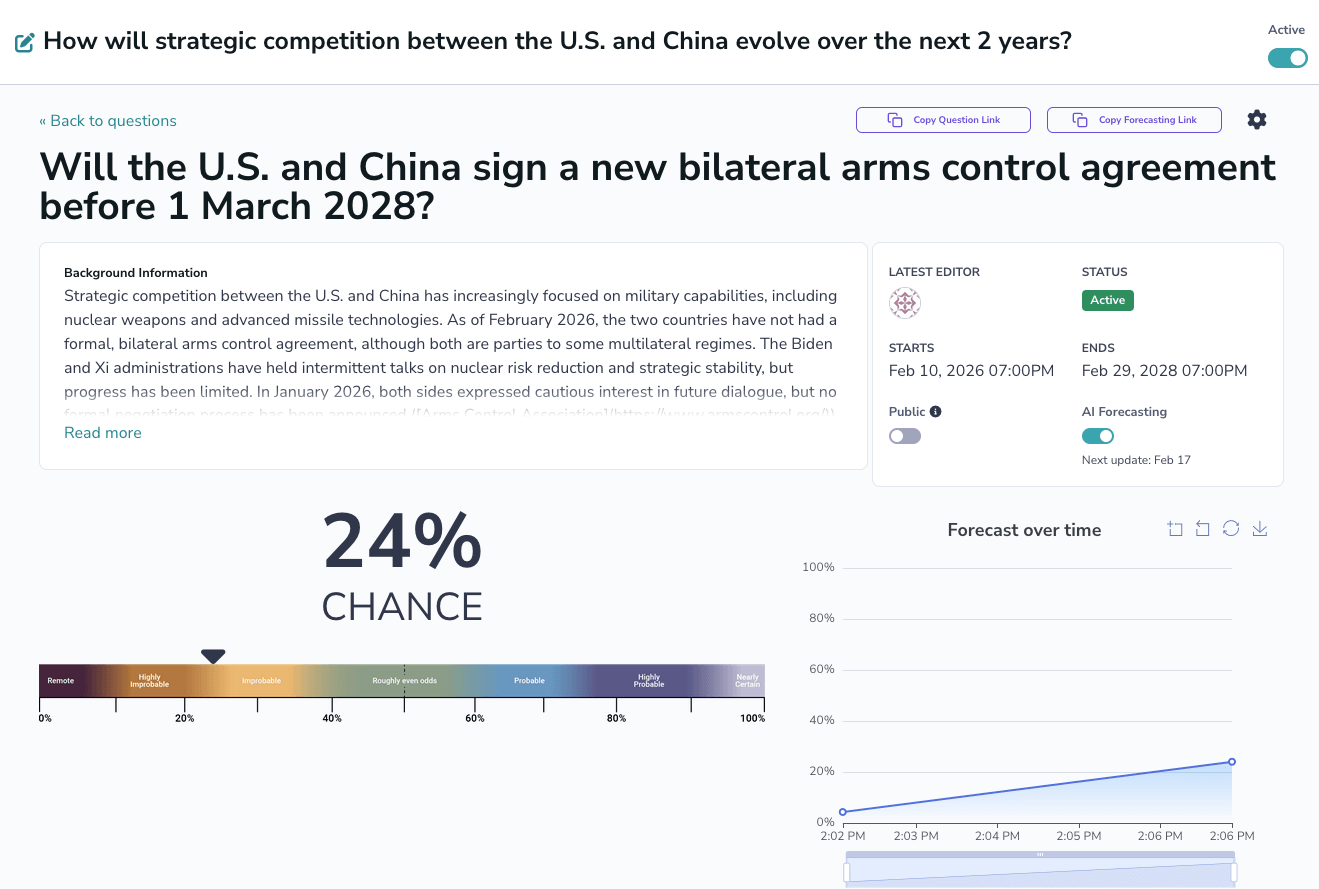
Human and machine judgment contribute different strengths. Human forecasters bring context, tacit knowledge, and the ability to recognize when the question itself may be wrong. Hinsley's AI Forecasting can research and update at greater frequency across many signals. Teams can inspect each source of judgment separately or combine them into one continuously updated forecast.
Two ways to bring human judgment into the forecast
Ongoing participation
Human+AI Hybrid Forecaster Networks
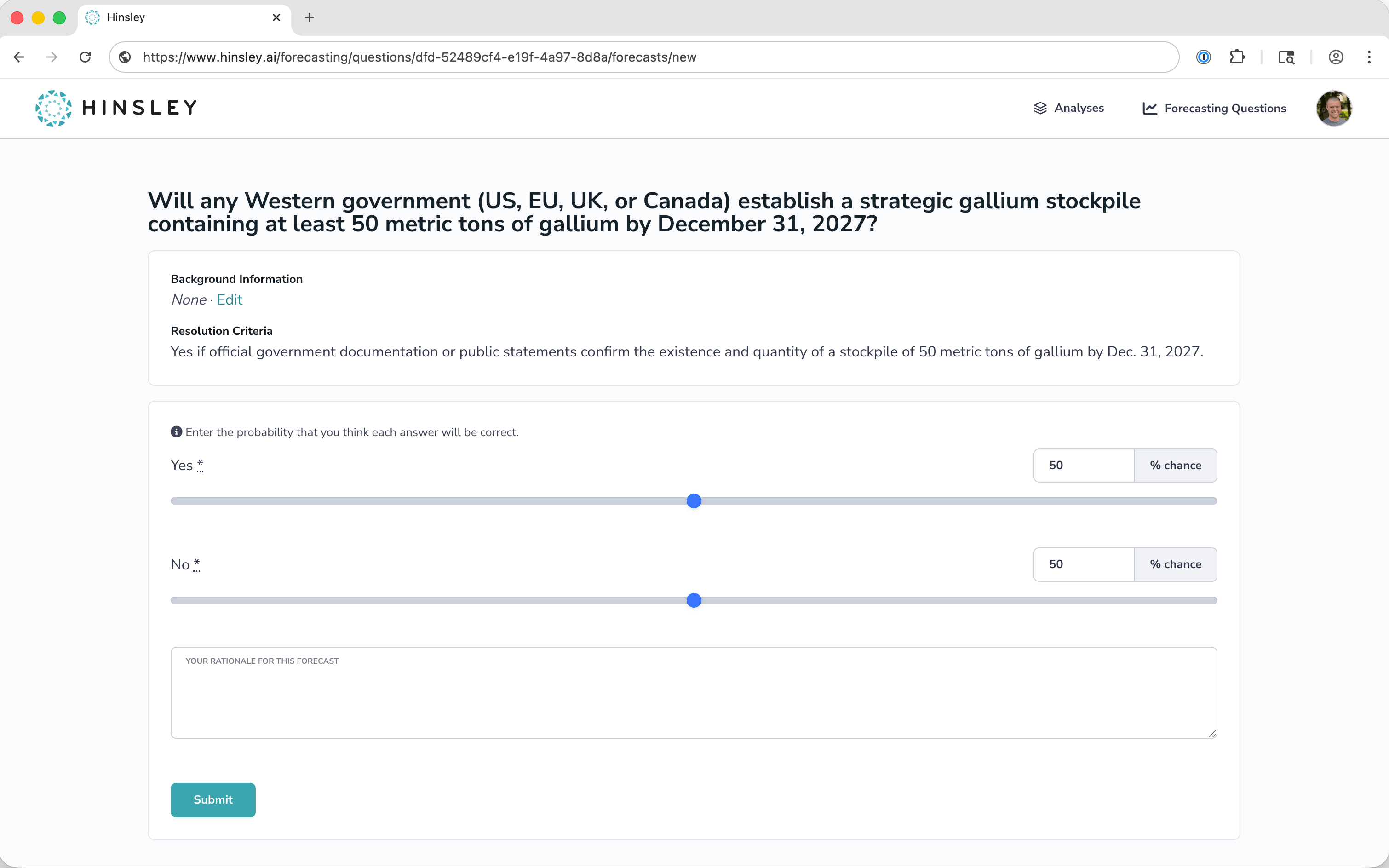
Publish questions to a standing group of employees, experts, partners, or professional forecasters on your own branded site. They forecast, explain their reasoning, discuss the evidence, and build a measurable accuracy record alongside Hinsley's AI forecaster. The Human+AI Hybrid Forecaster Networks page covers how a network works.
Targeted participation
Forecasting Campaigns
Create a focused, multi-step forecasting exercise for a defined decision or planning cycle. Campaigns can collect probability forecasts on questions and likelihood estimates across scenario sets in one guided sequence.
- Invite named participants, everyone in an account, or guests through a shareable link
- Mix required and optional question or scenario steps in the order you choose
- Track progress, completion, and individual responses
Why Crowdsourced Forecasting Matters
A well-run forecasting program helps teams:
- Replace ambiguous language such as "likely" with probabilities everyone can interpret
- Surface context, disagreement, and contrarian evidence that a single analyst or model may miss
- Compare human, AI, and combined forecasts without losing the component views
- Build an accountable record of what the organization believed, when it believed it, and how accurate those judgments proved to be
From Question to Continuously Updated Signal
- Frame a resolvable question - Define a clear outcome, deadline, and resolution criteria so every forecast answers the same question.
- Choose the right participation model - Publish to an ongoing panel, run a focused campaign, or forecast with the team already working in the analysis. Add Hinsley's AI Forecasting when you want an independent machine perspective.
- Collect probabilities and reasoning - Compare estimates, rationales, and source evidence before reviewing the aggregate.
- Update and measure - Reopen questions as evidence changes, preserve the forecast history, and evaluate calibration and accuracy after resolution.
Tips for Making Good Forecasts
Hinsley is especially useful when forecasting is a team exercise rather than a solo one. Analysts can invite internal stakeholders, collect outside judgment when needed, and compare how different rationales move the aggregate over time.
- Start with the outside view: Look to the base rate that a particular outcome occurs in similar situations.
- Adjust with the inside view: Evaluate what makes this particular circumstance unique.
- Seek contradictory information: Read opinions that take the opposing perspective.
- Conduct a pre-mortem: Ask yourself what factors might contribute to an unexpected result.