Scenario Builder
Build, test, and continuously reassess alternative futures rather than committing to one predicted outcome.
Alternative Futures That Can Be Tested
Strategic decisions rarely depend on one predicted future. Scenario analysis gives teams a disciplined way to describe meaningfully different outcomes, make their implications explicit, and judge how likely each has become.
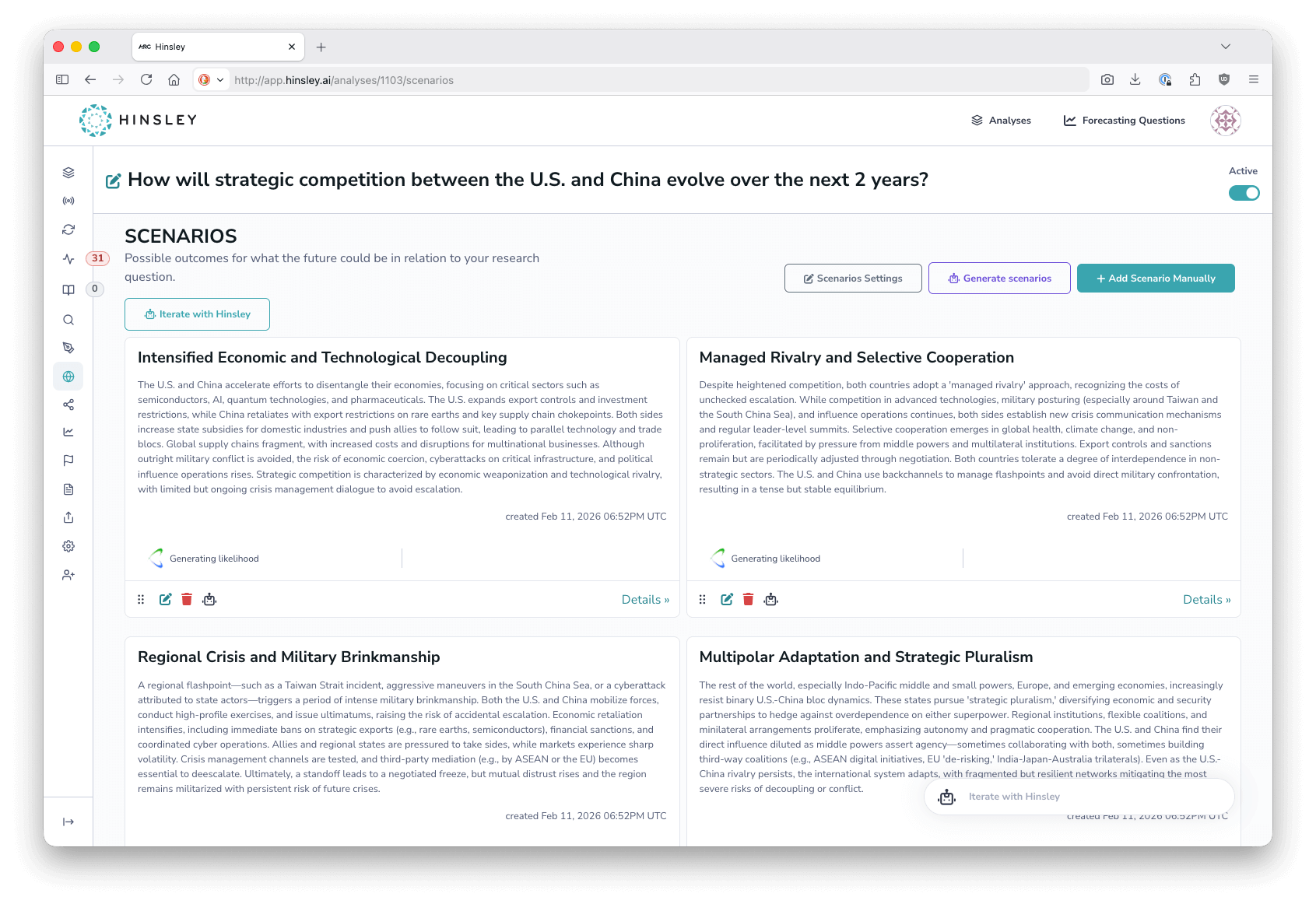
Hinsley can draft multiple scenario sets from the same question, test whether a set is genuinely distinct and collectively complete, and generate detailed, cited descriptions. Analysts can edit or clone any set, connect scenarios to drivers and forecast questions, and preserve both human and AI likelihood histories.
Why Scenario Analysis Matters
A living scenario practice helps teams:
- Explore alternatives quickly - Generate and compare more than one scenario set before choosing the best frame
- Expose structural weaknesses - Test overlap, missing outcomes, and relationships across a set
- Keep judgment visible - Preserve human and AI likelihoods, rationales, and changes over time
- Connect evidence to outcomes - Link scenarios to drivers, indicators, forecast questions, and cited research
- Reopen the right analysis - Reassess the primary scenario set when recurring research surfaces meaningful change
From Strategic Question to Living Alternatives
Hinsley keeps scenario creation connected to evidence, probability, and challenge:
- Define the decision-relevant question - Set the topic, time horizon, and conditions the alternatives must address.
- Build alternative sets - Generate one or more scenario sets, choose how many alternatives to explore, and decide whether the set should be mutually exclusive and collectively exhaustive.
- Test the structure - Validate overlap, gaps, and relationships before selecting a primary set. Clone and revise alternatives without losing earlier work.
- Develop the scenarios - Create cited descriptions, implications, resolution criteria, and links to the drivers and forecast questions that distinguish each future.
- Estimate likelihoods - Collect human judgments with Crowdsourced Forecasting and schedule AI Forecasting, while preserving each source and its history.
- Update with evidence - Global Intelligence Monitoring refreshes the evidence base and can reassess the likelihood of the primary scenario set as conditions change.
- Challenge the set - Use Red Teaming to probe missing futures, hidden assumptions, cognitive biases, and weak evidence.
From One-Time Exercise to Living Foresight
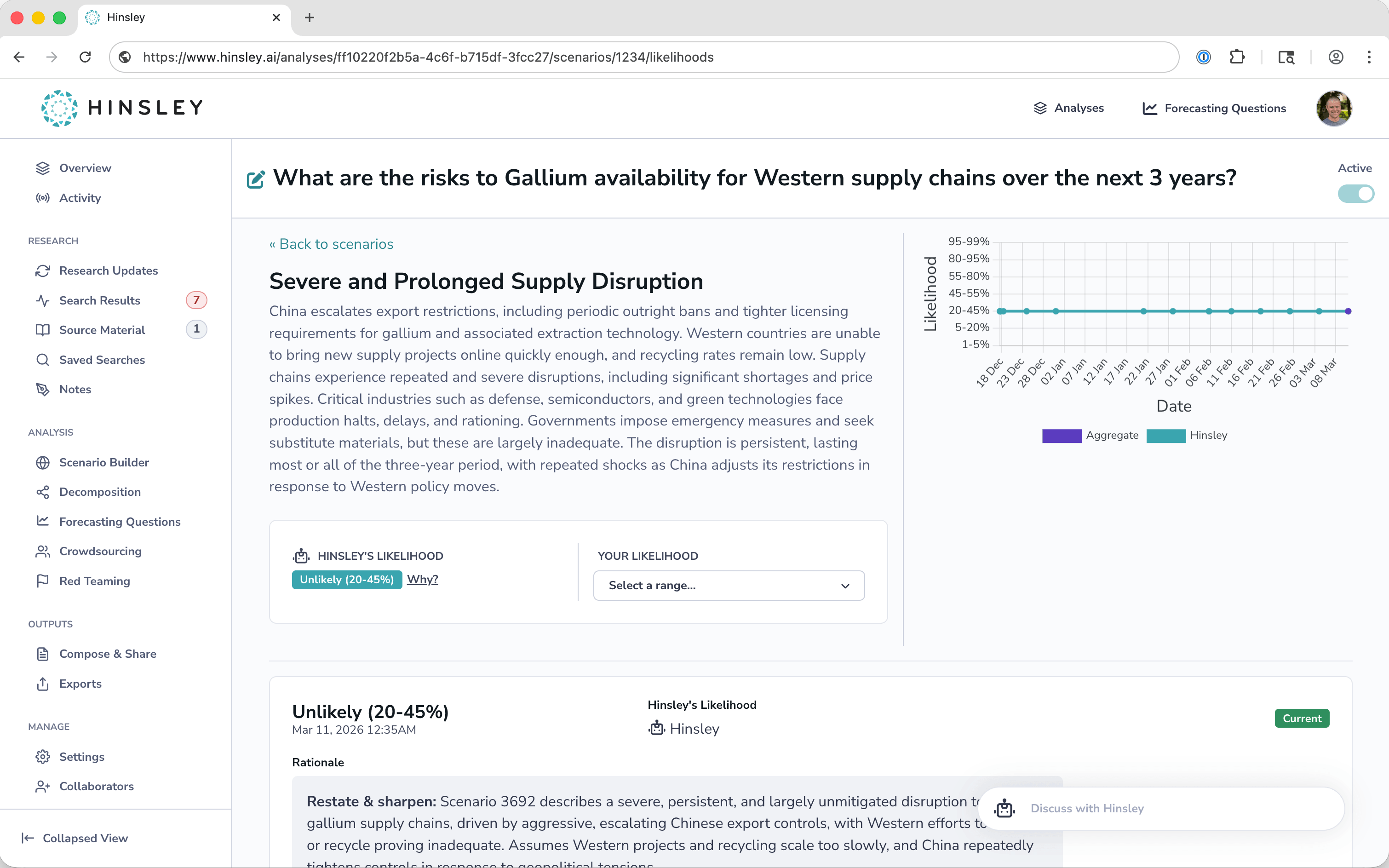
Traditional scenario planning produces a report that goes stale the moment it's finished. The world moves on, but the scenarios don't. Hinsley changes this by turning your scenarios into a continuously monitored foresight system that evolves alongside the situation.
Hinsley runs automated Global Intelligence Monitoring on a weekly basis for every active analysis - scanning global news, open-source intelligence, and your curated source material for new developments. When the research cycle completes, Hinsley automatically reassesses the likelihood of each scenario in light of the new evidence, producing updated probability estimates with structured rationales explaining the reasoning behind any shifts.
As new information shifts the balance between scenarios, Hinsley surfaces those changes and alerts you. If a low-probability scenario starts gaining ground or a leading scenario weakens, you'll know before it becomes obvious - giving your team the lead time to adjust strategy, reallocate resources, or escalate to leadership.
Because scenarios live in a shared workspace, teams can review those shifts together, compare interpretations, and refine the implications before leadership asks for an update.
The result is a set of scenarios that doesn't just describe possible futures at a point in time, but actively tracks which futures are becoming more or less likely. Instead of reconvening the planning team months later to start over, you have a continuously updated foresight picture that keeps pace with reality.