Global Intelligence Monitoring
Continuously search, filter, and synthesize open and proprietary sources around the questions your team is tracking.
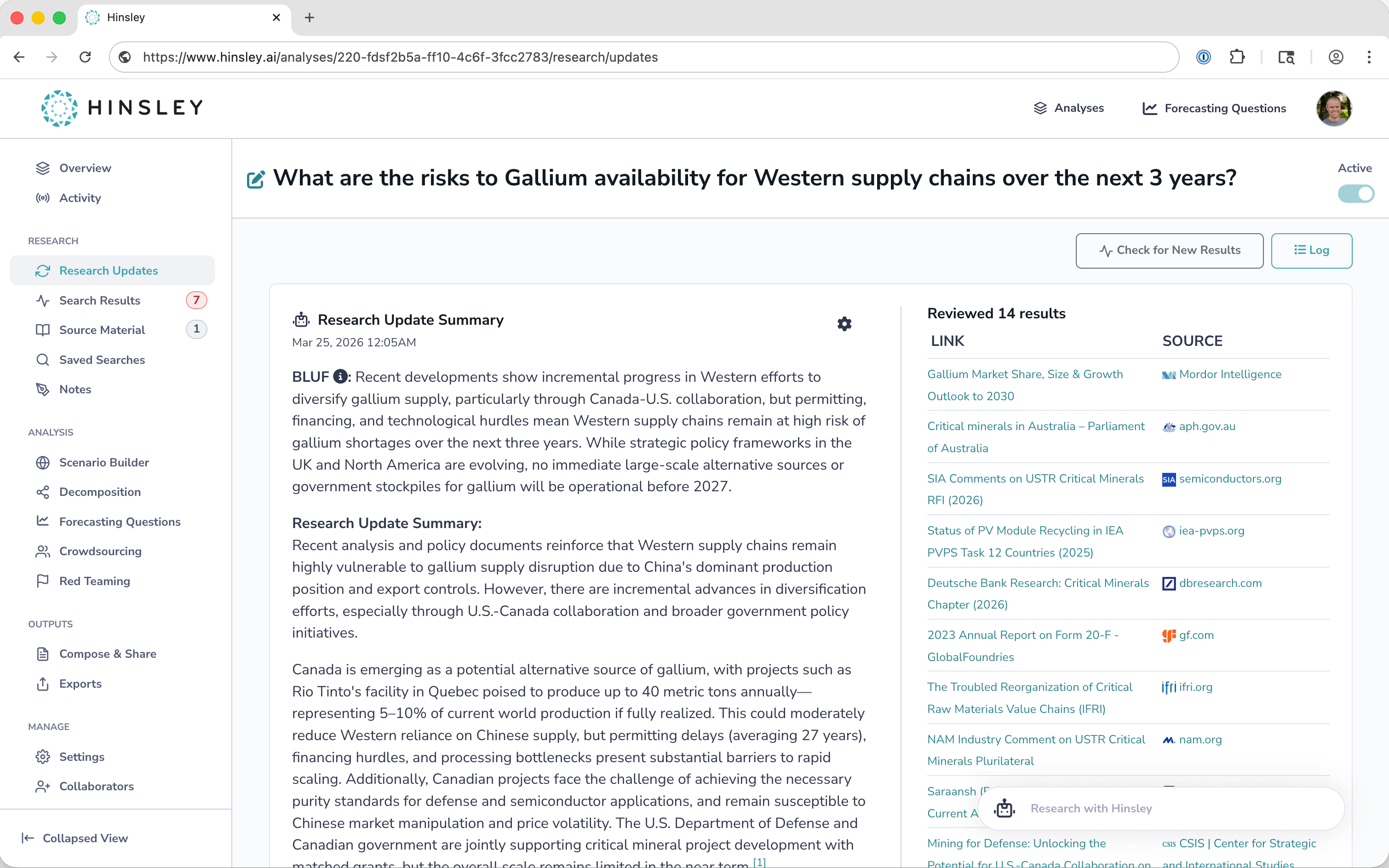
Continuous AI Research
Keeping up with fast-moving global developments is one of the hardest parts of any analytical effort. Important signals get buried in noise, relevant articles go unread, and by the time you revisit your analysis, the landscape has already shifted. Hinsley solves this by running ongoing AI research tailored to each of your analysis topics.
Configure the sources and boundaries that matter to the question, including open web, global news, uploaded material, a local corpus, relevant or excluded keywords, domains, countries, and languages. AI relevance filtering reduces noise before results reach the analyst.
Recurring research produces a cited Research Brief and an Update Summary focused on what changed. Analysts can save important results into the evidence base, upload private documents, and use the same material across scenarios, forecasts, chat, and written outputs.
Those findings feed directly into the rest of your analytical workflow. New documents inform your Decomposition, provide evidence for scenario refinement, and ground your AI Forecasting in current intelligence. Everything stays connected.
Incorporate Your Own Content
Open-source monitoring is only part of the picture. Hinsley also lets you upload your own private documents so the analysis can reflect internal reporting, proprietary research, customer material, briefings, and other context that never appears on the public web.
Those private sources become part of the working evidence base for the analysis, giving Hinsley more relevant context when generating briefs, update summaries, scenarios, forecasts, and outputs. The result is monitoring that is not just current, but specific to what your team already knows.
Research Briefs & Update Summaries
Hinsley distills the flow of ongoing research findings into two types of AI-generated summaries. Research Briefs provide a comprehensive, structured overview of everything known about your analysis topic - a single document you can hand to a colleague or stakeholder to get them up to speed. Update Summaries focus on what's changed since your last check-in, highlighting new developments and shifting dynamics so you can quickly assess whether the situation has moved.
Both summaries lead with The Bottom Line - a concise assessment of the key takeaway - followed by detailed analysis. This mirrors the format used by intelligence professionals to ensure decision-makers get the most important information first.
Add Your Own Sources And Save What Matters
01
Discover
Ongoing monitoring surfaces new reporting and developments, but analysts can also decide which findings deserve to become part of the long-term evidence base.
02
Curate
Save important search results into Source Material, upload private documents, or add URLs directly so Hinsley can work from both open-source discovery and the sources your team already trusts.
03
Reuse
Those curated sources stay available across the rest of the workflow, grounding scenarios, decomposition, forecasting, chat, and written outputs in evidence that combines public and private context.
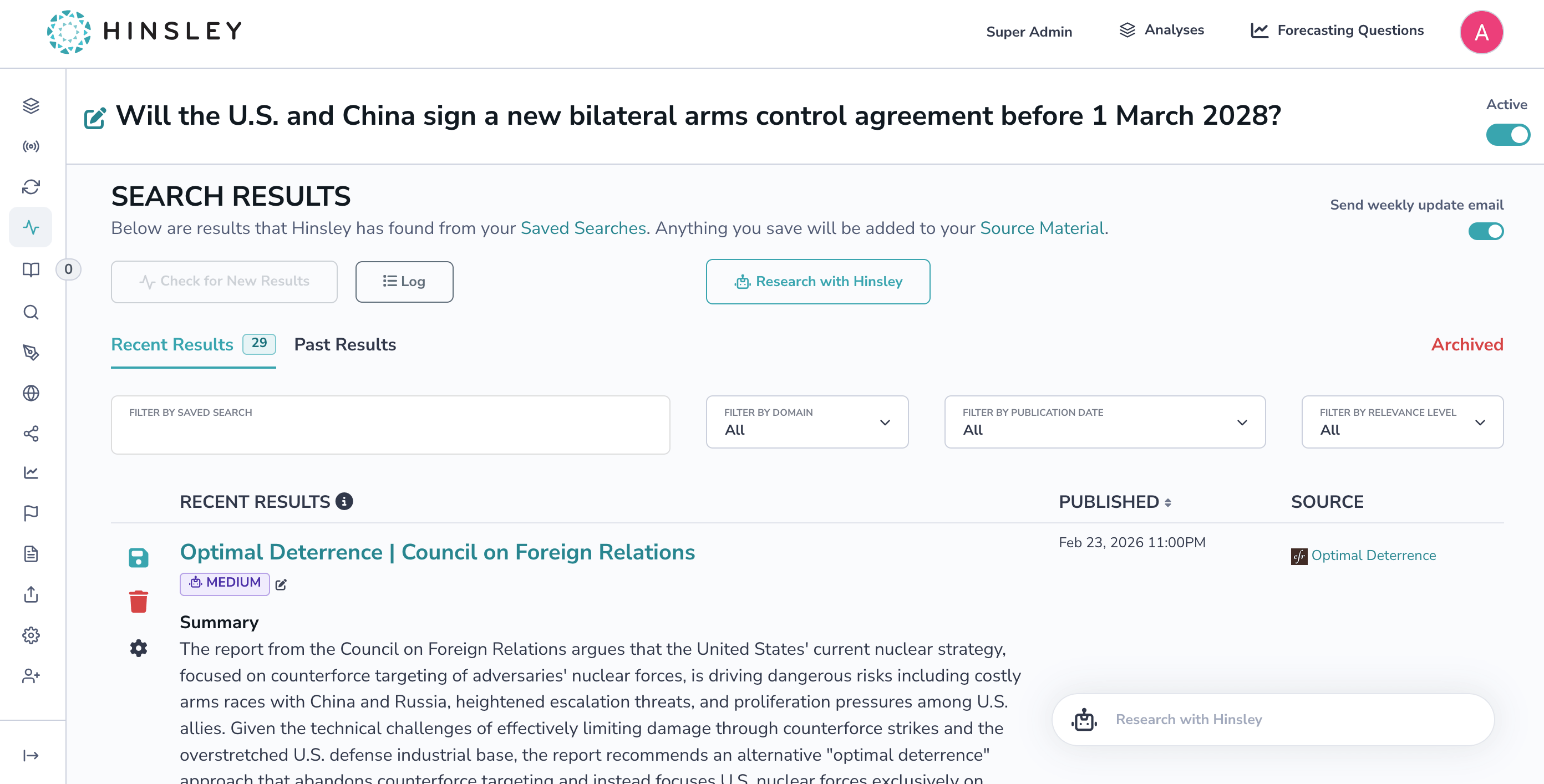
Weekly Intelligence Digests
Hinsley delivers a weekly email digest for each of your active analyses, summarizing notable new findings, scenario likelihood changes, and forecast movements in a single view. Emails are only sent when there is genuinely new information - no empty updates cluttering your inbox.
The digest is designed to be a decision point: scan the summary, decide whether the situation warrants deeper attention, and click through to the full analysis if it does. For teams managing multiple analysis topics, this means staying current across your entire portfolio without having to manually check each one.
That shared rhythm matters operationally: teammates can review the same update summary, align on what changed, and decide who should dig deeper or brief leadership next.