Red Teaming
Challenge a decomposition or scenario set through a focused AI conversation, then track what the team does with every finding.
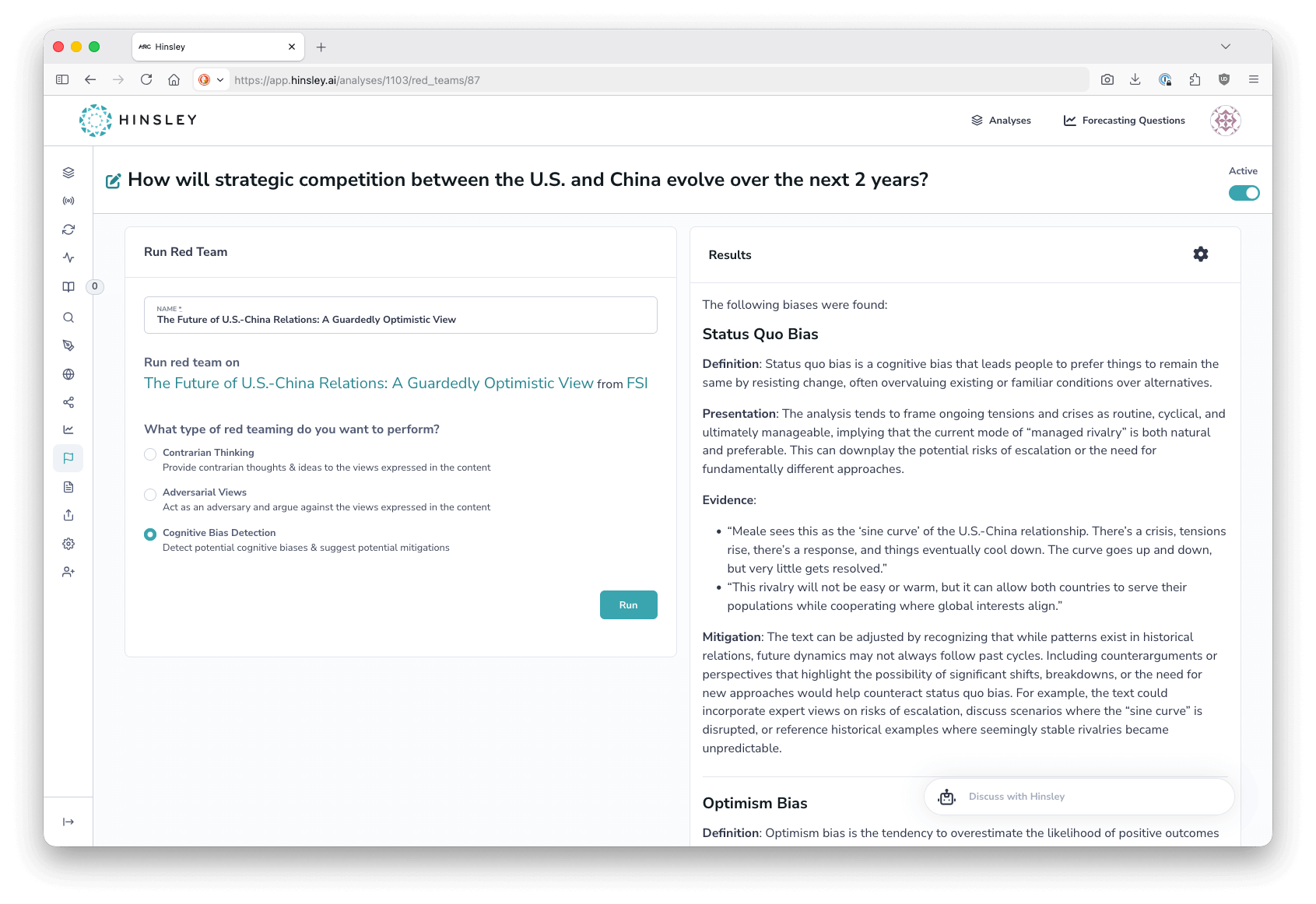
Structured Challenge, Not a One-Off Prompt
Analytical challenge is most useful when it is directed at a specific artifact and produces findings the team can address. A generic request to "be critical" rarely creates that discipline.
Hinsley opens a focused challenge session against a decomposition or scenario set. Teams can choose a general review or a specific lens, including contrarian analysis, cognitive biases, hidden assumptions, evidence gaps, or structural completeness, then continue the inquiry as a conversation.
Why Red Teaming Matters
Structured challenge helps teams:
- Direct scrutiny at a specific analytical artifact rather than a generic conclusion
- Examine the same work through multiple, explicit challenge lenses
- Preserve the dialogue and findings for later review
- Show which concerns were addressed, accepted, or dismissed
From Challenge to Accountable Finding
Hinsley keeps the challenge connected to the work it is testing:
- Select the work to challenge - Open a decomposition or set of scenarios directly in a red-team session.
- Choose a lens - Run a broad review or focus on contrarian arguments, cognitive biases, assumptions, evidence gaps, or structural completeness.
- Interrogate the critique - Continue the conversation, test the reasoning, and separate useful findings from weak objections.
- Resolve the findings - Track each issue as open, addressed, accepted risk, or dismissed, with the record preserved alongside the analysis.