Decomposition
Turn a broad strategic question into an editable system of drivers, leading indicators, and forecastable signals.
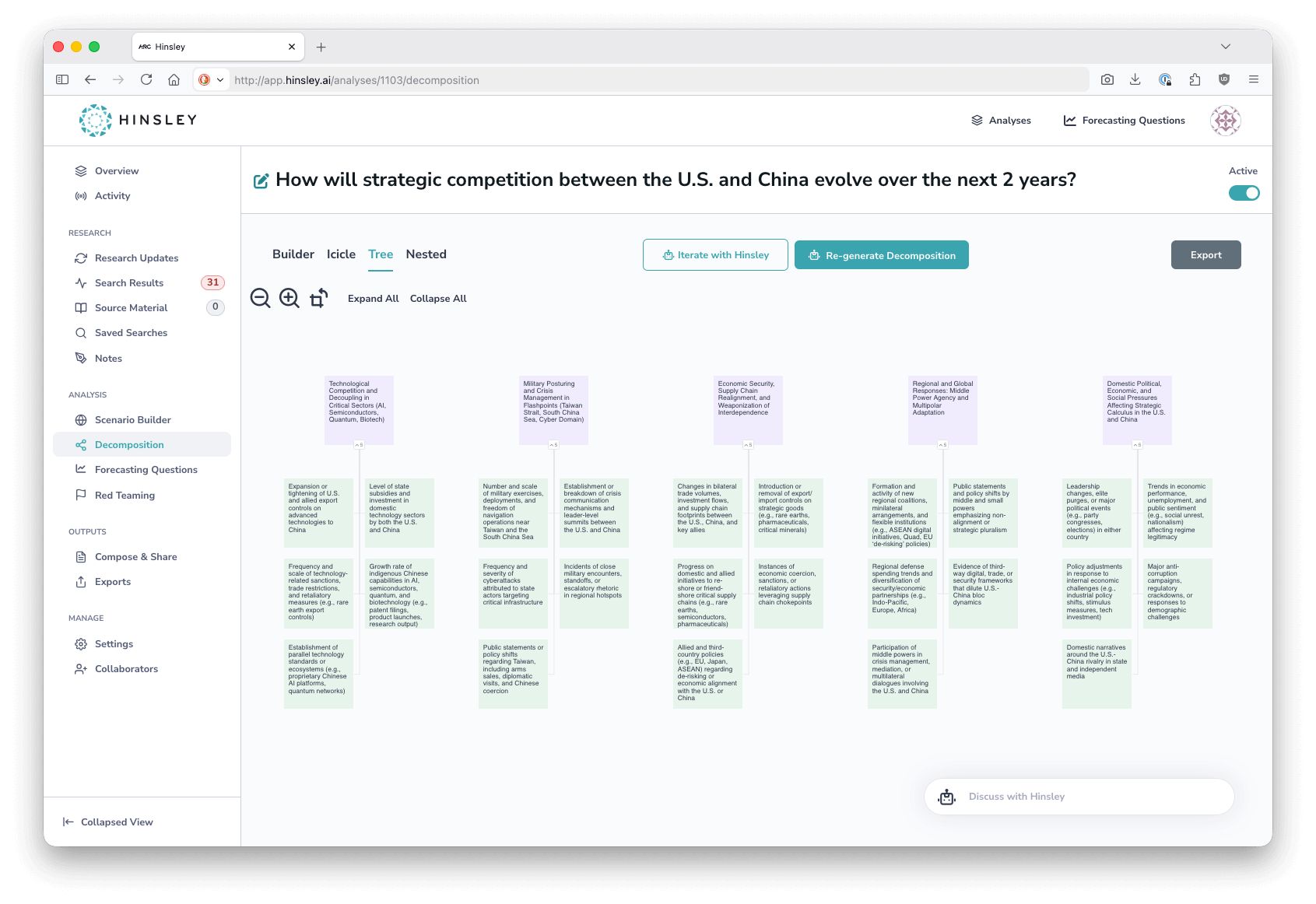
A Visible Model of the Problem
The concept of analytic decomposition was popularized by CIA analyst Richards J. Heuer in Psychology of Intelligence Analysis as a way to counter human biases and make the analytic process more transparent and collaborative. Intelligence analysts are trained on decomposition to clarify priorities, assign monitoring responsibility, and provide decision-makers with actionable intelligence.
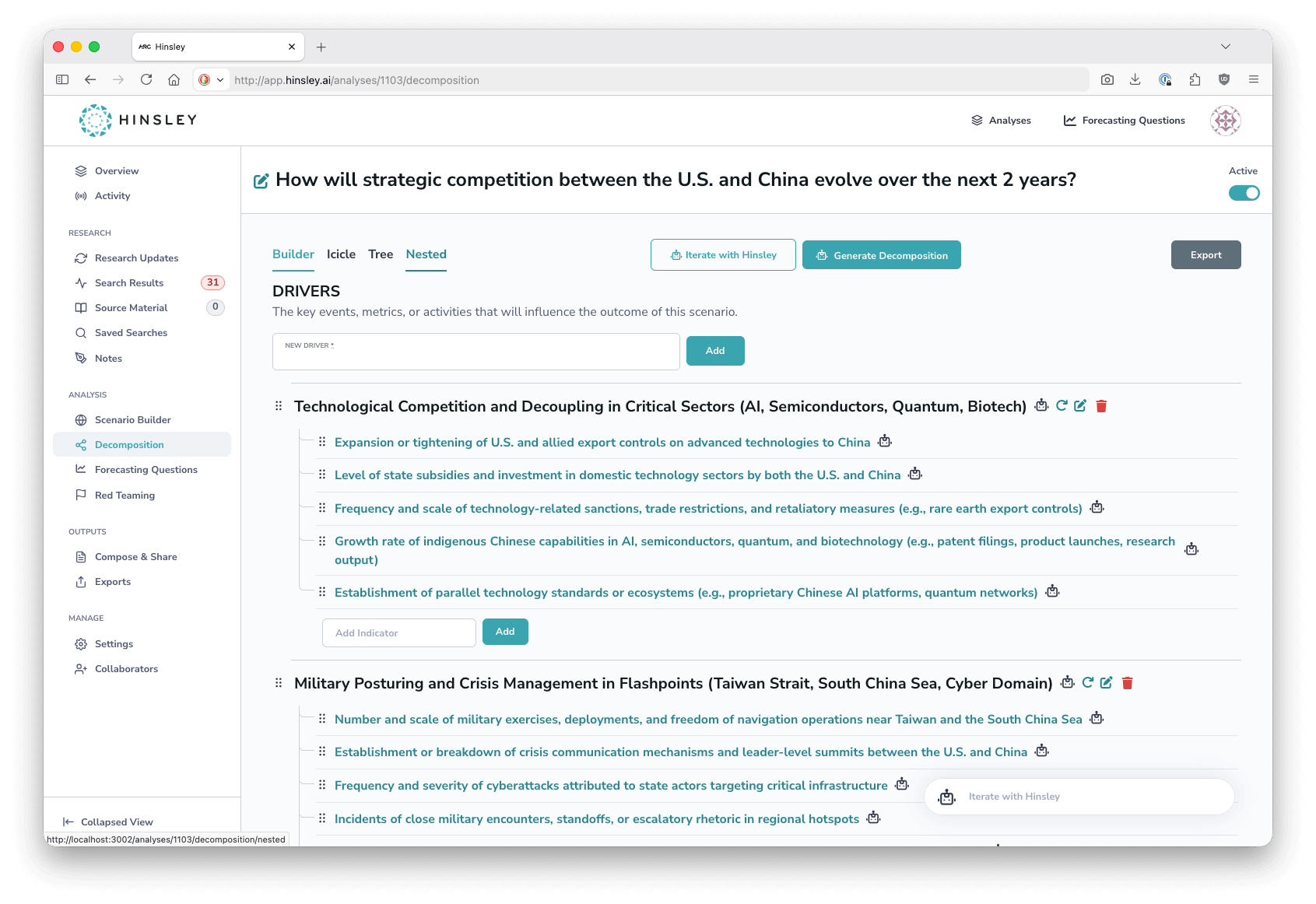
In Hinsley, a decomposition is an editable framework rather than a fixed diagram. Teams can generate an initial structure with AI, add and reorder drivers and indicators, keep alternate versions, and turn the signals that matter into forecast questions.
Drivers & Indicators
A decomposition starts by identifying drivers - the major forces that will shape the outcome of your analysis topic. Hinsley can draft the initial structure, while analysts remain free to add, edit, reorder, regenerate, or clone the framework as their understanding changes.
Each driver is broken into leading and lagging indicators - observable signals that show where a force may be heading and what has already changed. Teams can group indicators, compare them in tree, icicle, or nested views, and generate forecast questions for the signals that require continuous measurement.
Why Decomposition is Useful
Nobel laureate Daniel Kahneman described a cognitive bias he called What You See Is All There Is (WYSIATI) - the tendency to make judgments based only on the information immediately in front of you, ignoring what you don't know. Decomposition is a direct counter to this. By systematically mapping the full landscape of drivers and indicators, it forces you to look beyond the headlines and surface the forces that will actually shape the outcome, giving you a fuller, more structured understanding of how a topic is likely to unfold.
For decision-makers and leaders, decomposition helps to:
- Assign ownership by allocating staff or teams to monitor specific drivers or indicators
- Create a shared world view, surfacing underlying assumptions that may differ across stakeholders
- Identify hidden risks or opportunities that might otherwise be missed
For analysts, decomposition helps to:
- Routinely monitor, update, and refine how an issue is assessed with new information
- Facilitate more accurate risk assessments and prioritization through detailed evaluation
- Build an agile framework for ongoing events that can be adapted as circumstances change
From Static Analysis to Continuous Monitoring
Most structured analytic exercises end the same way - a workshop produces a report, the report gets filed, and the insights go stale. The world moves on, but the analysis doesn't. Hinsley changes this by turning your decomposition into a living framework that continuously monitors and forecasts the situation as it evolves.
Once you've identified your drivers and indicators, Hinsley can generate forecasting questions for each indicator and schedule AI Forecasting that run automatically on a cadence you choose. Multiple frontier AI models independently research the latest developments, reason through the evidence, and produce probability estimates - complete with structured rationales explaining their thinking. As new information emerges, forecasts update and surface changes, alerting you when the status quo shifts.
Your decomposition also serves as the foundation for Scenario Builder. Hinsley uses your drivers to generate plausible future scenarios and assign likelihoods, giving you a structured view of how the situation could play out. As indicator forecasts update, you'll be alerted to changes in the likelihood of your scenarios.
The result is a decomposition that doesn't just describe the landscape at a point in time, but actively tracks how it's changing. Instead of revisiting your analysis months later and starting from scratch, you have a continuously updated picture of which drivers are moving, which indicators are signaling change, and where to focus your attention.
Case Study: U.S. Competitiveness in Microelectronics
See how Cultivate Labs used decomposition to help U.S. government policymakers break down a complex geopolitical question into trackable drivers and measurable signals.